How NHS sick pay works
If you're on Agenda for Change terms, the NHS pays sick pay on top of Statutory Sick Pay, set out in section 14 of the NHS terms and conditions. How much you get depends on your years of NHS service.
| Your service | Full pay | Half pay |
|---|---|---|
| First year | 1 month | 2 months |
| Second year | 2 months | 2 months |
| Third year | 4 months | 4 months |
| Fourth or fifth year | 5 months | 5 months |
| Over 5 years | 6 months | 6 months |
After that, you get Statutory Sick Pay only, £123.25 a week, until 28 weeks from the start. Then sick pay stops.
Does NHS sick pay include SSP?
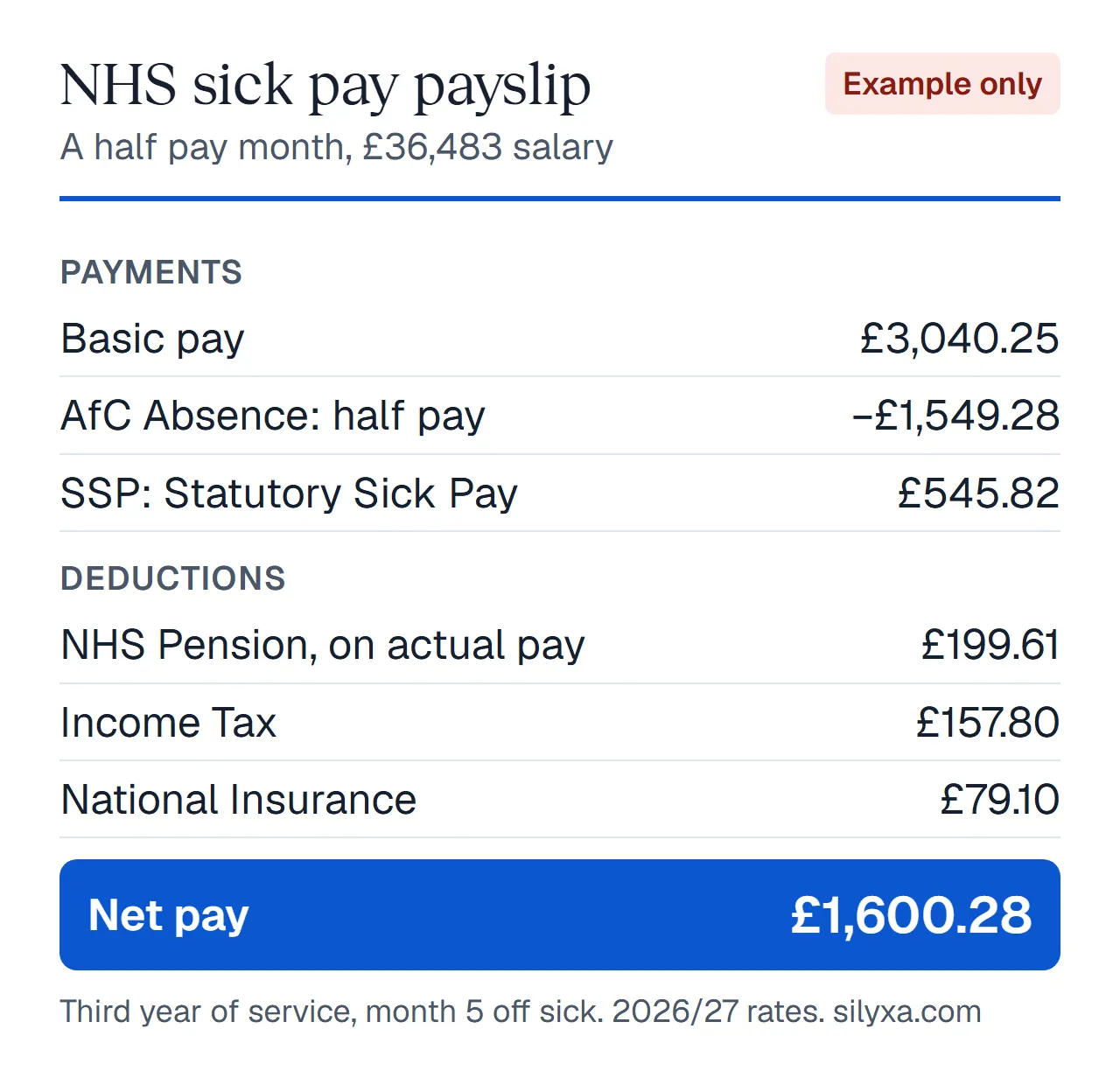
Yes. Full pay already includes your Statutory Sick Pay, so you don't get both. On half pay, SSP is added, but half pay plus SSP can never come to more than your full pay. On payslips this often shows as an "AfC Absence" deduction from basic pay and a separate SSP line.
When does NHS sick pay reset?
It doesn't reset on a fixed date. On the first day of each absence, your employer takes your full entitlement and subtracts any paid sick leave in the 12 months before that day. Each sick day stops counting 12 months after you took it, so your entitlement comes back day by day. It's fully restored 12 months after your last paid sick day.
Unpaid sick leave, and absence from an injury or illness caused by your NHS work, don't count towards the 12 months.
Does NHS sick pay include unsocial hours?
It depends on where you work.
- England: since 1 July 2018, full sick pay is your basic pay plus any high cost area supplement and pay protection. Unsocial hours payments aren't included, unless you were employed by 30 June 2018 on £18,160 or less, or you're off with an injury at work. On £400 a month of unsocial hours, 30 days off costs you about £253 of take-home even on full sick pay.
- Wales: regular supplements, such as unsocial hours, aren't paid for the first week off. From the second week they are, based on your last 3 months.
- Scotland and Northern Ireland: full sick pay includes your regular supplements, based on your last 3 months.
What NHS sick pay does to your take-home
In your third year of service you get 4 months of full pay and 4 of half pay. On £36,483, 200 days off pays £17,395 in sick pay, and your take-home over that time falls by about £1,665. Income Tax, National Insurance and NHS Pension all fall on half pay, so your take-home drops by less than your pay. Add your first day off sick to see each month.
NHS sick pay questions
Do you get NHS sick pay in your first year?
Yes, from your first day. In your first year you get 1 month of full pay and 2 months of half pay.
Is NHS sick pay based on a rolling 12 months?
Yes. Paid sick leave in the 12 months before each absence comes off your entitlement. Enter those days above, and the date of your last paid sick day.
Do I pay NHS Pension contributions on sick pay?
Yes, on the pay you actually get. On full pay that's your normal contribution. On half pay or SSP only, it's worked out on that lower pay, while your employer still pays its share on your normal pay. If your pay stops, contributions stop too.
What happens when NHS sick pay runs out?
You get Statutory Sick Pay until 28 weeks from the start of your absence, if you haven't used it. After that, your employer must give you form SSP1 so you can claim Universal Credit or Employment and Support Allowance. In some long absences, sick pay is reinstated at half pay (paragraph 14.10).
How are months counted?
NHS payrolls count entitlement in calendar days, weekends included. This calculator counts each month as 30 days, so 6 months is 183 days.
Does this work for doctors?
It's built for Agenda for Change staff. Doctors and dentists have their own terms, though their sick pay scale is similar.
Is this official?
No. It follows section 14 of the NHS terms and conditions handbook, but your trust or board's payroll makes the final calculation.
Sources
Checked on 7 November 2026 against the 2026/27 tax year.