
How is a bonus taxed in the UK?
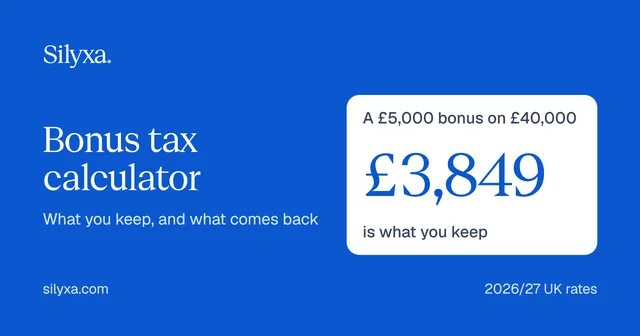
There is no special tax rate for a bonus. It is added to your pay, and Income Tax, National Insurance and any student loan come off it like the rest of your wages. Because it sits on top of your salary, it is taxed at your highest rate: on £40,000 a year, a £5,000 bonus is all basic rate, so £1,000.00 of Income Tax over the year.
| Salary | Bonus | Income Tax | National Insurance | You keep | Share kept |
|---|---|---|---|---|---|
| £30,000 | £3,000 | £600.00 | £161.34 | £2,238.66 | 74.6% |
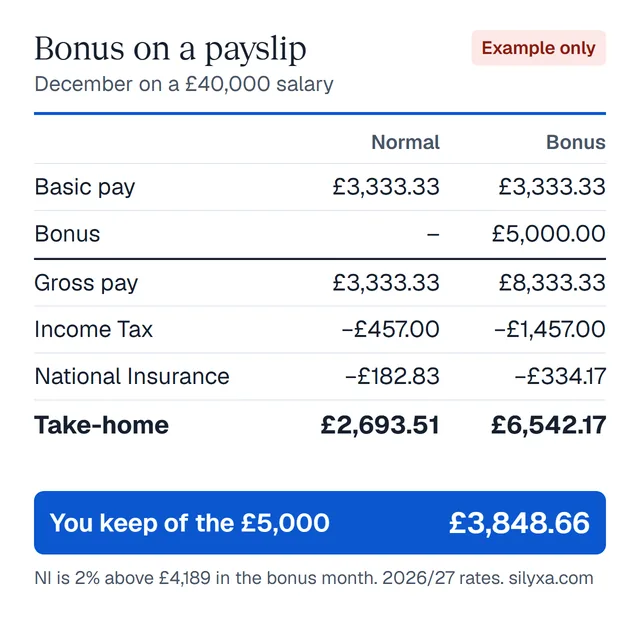
| £40,000 | £5,000 | £1,000.00 | £151.34 | £3,848.66 | 77.0% |
| £48,000 | £5,000 | £1,544.00 | £111.34 | £3,344.66 | 66.9% |
| £60,000 | £10,000 | £4,000.00 | £200.00 | £5,800.00 | 58.0% |
| £95,000 | £20,000 | £11,000.00 | £400.00 | £8,600.00 | 43.0% |
| £130,000 | £20,000 | £9,000.00 | £400.00 | £10,600.00 | 53.0% |
Why your bonus month looks over-taxed
PAYE works out tax on your pay for the tax year so far. In the month a bonus is paid, it uses the tax-free allowance and tax bands built up to that month, so a bonus early in the tax year can be taxed at 40% that month even if your year stays in the basic rate. The extra comes back as lower tax in the months after, as long as you are on a normal tax code.
| Paid in | Tax that month | The bonus's share of the year | Comes back later |
|---|---|---|---|
| April | £1,828.67 | £1,000.00 | £828.67 |
| July | £1,314.67 | £1,000.00 | £314.67 |
| December | £1,000.00 | £1,000.00 | £0.00 |
| March | £1,000.00 | £1,000.00 | £0.00 |
Paid in April, £1,828.67 of tax comes off the bonus that month, against £1,000.00 over the year, so £828.67 comes back. On an emergency code ending W1 or M1, each month is taxed on its own, so nothing evens out in payroll; you get the money back after the tax year, or sooner if HMRC sends your employer a new code.
National Insurance and student loan on a bonus
These work differently from Income Tax. They are worked out on each month's pay on its own, and a bonus counts as part of the pay of the month it is paid in, even on a separate payday (HMRC employer guide CWG2, section 1.12). So NI on the bonus month is 8% up to £4,189 and 2% above it: on £40,000 with a £5,000 bonus that is £151.34, not 8% of the whole bonus. It doesn't even out over the year.
Student loan is the same: 9% of the month's pay over the monthly threshold. On £24,000 with a £3,000 bonus on Plan 2, £229.61 goes to your loan that month. If your income for the whole tax year stays under the yearly threshold, you can ask the Student Loans Company for that back after the year ends.
The 60% tax trap
Above £100,000 of adjusted net income you lose £1 of tax-free allowance for every £2, until it's gone at £125,140. In that range, a bonus is taxed at an effective 60%, plus NI. On £95,000 with a £20,000 bonus, you keep £8,600.00, or 43.0%. Putting part of the bonus into your pension through salary sacrifice lowers your adjusted net income and brings the allowance back.
Putting your bonus into your pension
Many employers let you swap all or part of a bonus for a pension contribution, called bonus sacrifice. It leaves your pay before tax and NI, so the whole amount reaches your pension, while you only give up the take-home you'd have kept. Choose a share under More options above to see it on your payslip.
Bonus tax questions
Do you pay 40% tax on bonuses?
Only on the part that takes your income for the year over the higher rate threshold, £50,270 in England, Wales and Northern Ireland. The rest is taxed at your usual rate. A bonus month can look like 40% because PAYE works on the year to date, and the extra comes back later.
How much tax should be taken from a bonus?
Over the year, your marginal rate: 20%, 40% or 45%, plus NI of 8% or 2%. In the month itself it can be more, depending on which month it is paid in. The calculator shows both.
Is it better to earn £50,000 or £55,000?
£55,000 always leaves you more. Almost all of the extra £5,000 is above the higher rate threshold, so it is taxed at 40% plus 2% NI, and you keep about £2,940 of it. No pay rise or bonus leaves you worse off, though the 60% trap and student loans reduce how much of it you keep.
Will I get the tax back?
Overpaid Income Tax comes back in later months on a normal tax code. National Insurance doesn't, because it's worked out on each month on its own. Student loan comes back only if your income for the year is under your plan's yearly threshold, and then from the Student Loans Company.
Is this official?
No. It follows HMRC's PAYE rules and employer guide, but your employer's payroll makes the final calculation, and their pay dates and tax code can change the month you see.
How this calculator works
Bonus tax adds the bonus to the pay of the month it is paid in. Income Tax is cumulative PAYE, so the month's tax depends on which tax month it lands in, and any excess comes back in later months on a normal code; on an emergency code each month stands alone. National Insurance and student loan are worked out on that month's pay on its own (HMRC employer guide CWG2, section 1.12), so they don't even out. What you keep is the year's take-home with the bonus less the year's take-home without it, assuming monthly pay and a full year in the job.
Sources
Checked on 12 November 2026 against the 2026/27 tax year.
- GOV.UK Employer further guide to PAYE and National Insurance, section 1.12
- GOV.UK Student loan repayment guidance for employers
- GOV.UK Repaying your student loan
- GOV.UK What your tax code means
- GOV.UK Adjusted net income
- GOV.UK Salary sacrifice for employers
- GOV.UK Income Tax rates and allowances
- GOV.UK Rates and thresholds for employers 2026 to 2027
Update history
- 12 November 2026: Added.