
How the Carer's Allowance earnings limit works
You can work and get Carer's Allowance if your earnings are £204 or less a week after Income Tax, National Insurance and expenses (GOV.UK). The allowance is £86.45 a week. It is a cliff edge: earn even 1p over the limit in a week and you get no Carer's Allowance for that week, however small the excess.
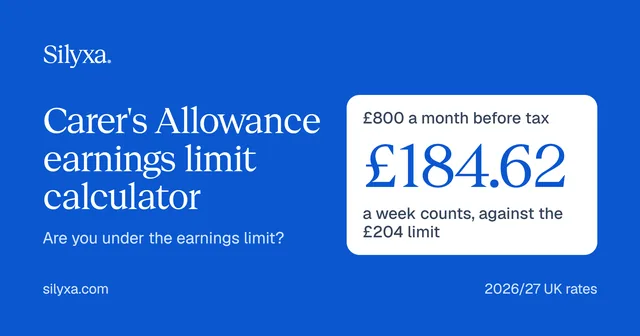
So the question is not your pay before tax but your earnings after the deductions DWP allows, turned into a weekly figure. On £800 a month before tax, with no pension or care costs, that is £184.62 a week, £19.38 under the limit.
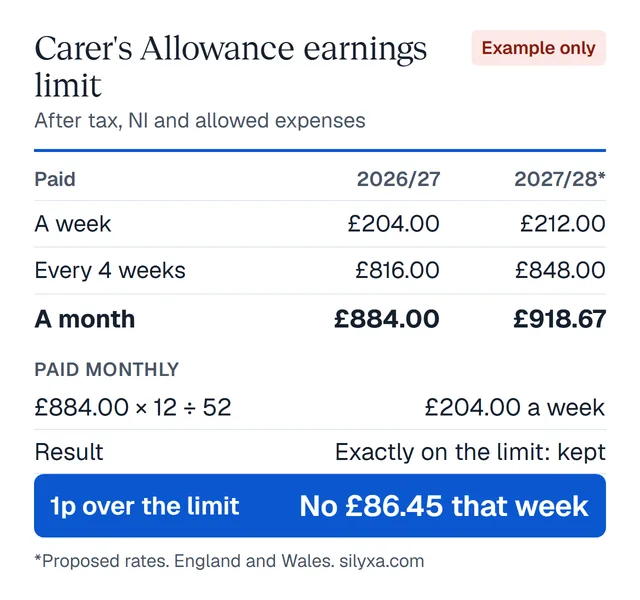
| Year | A week | Every 4 weeks | A month |
|---|---|---|---|
| 2026/27 | £204.00 | £816.00 | £884.00 |
| 2027/28 (proposed) | £212.00 | £848.00 | £918.67 |
Carer's Allowance earnings limit if you are paid monthly
Monthly pay is not divided by 4. Regulation 8 of the Social Security Benefit (Computation of Earnings) Regulations 1996 turns a month's pay into a weekly amount by multiplying by 12 and dividing by 52. So the £204 limit is £884.00 a month after deductions, not £816. Pay every 4 weeks is divided by 4, and pay every 3 months is multiplied by 4 and divided by 52.
What you can take off your earnings
- Income Tax and National Insurance taken from your pay.
- Half of your pension contributions. On £900 a month with £40 a month into a pension, £4.62 a week comes off, leaving £203.08 a week, which takes it under the limit.
- Expenses you need for the job: equipment such as specialist clothing, and travel between different workplaces that your employer does not pay for. If you are self-employed, GOV.UK lists business costs here too.
- Care costs you pay someone to look after the person you care for, or your children, while you work, up to half of your earnings after the deductions above. The carer must not be your spouse, partner, parent, child or sibling. On £100 a week after tax, NI and other expenses with £60 of care, £50 counts, leaving £50, as in the GOV.UK example.
Some money does not count as earnings at all, such as an occupational or private pension, a loan or advance from your employer, and contributions to living costs from someone you live with who is not a tenant or boarder.
If your pay changes from week to week
When your earnings go up and down, regulation 8(3) lets DWP work out a weekly average: over one complete cycle of work if you have a pattern, counting the weeks you do not work, or otherwise over five weeks or another period that gives a fair weekly figure. Choose Pay changes above, then enter all the pay for those weeks and how many weeks it covers.
April 2027 and the planned taper
The proposed rates for 2027/28 raise the allowance to £89.50 a week and the earnings limit to £212 a week (GOV.UK, proposed benefit and pension rates 2027 to 2028). Choose 2027/28 under More options to check your pay against them.
The Budget 2026 replaces the cliff edge with a taper, planned for 2030-31 in England and Wales: you will lose £1 of allowance for each £1 of earnings over the limit, instead of losing it all. On £1,000 a month with no tax or NI, earnings of £230.77 a week are £26.77 over today's limit, so today you get nothing that week; under the taper you would get £59.68. Until the taper starts, the cliff edge applies.
Carer's Allowance earnings questions
How much can I earn and still get Carer's Allowance?
£204 a week in 2026/27, after tax, NI and allowed expenses. Before those deductions you can usually earn more: enter your pay above to see your own figure.
What is the Carer's Allowance earnings limit a month?
£884.00 a month after deductions, because monthly pay is turned into a weekly figure by multiplying by 12 and dividing by 52.
What happens if I go over the limit?
You get no Carer's Allowance for that week. Tell the Carer's Allowance Unit about changes to your earnings, because payments made while you were over the limit can be taken back as an overpayment.
Can I work full time and get Carer's Allowance?
GOV.UK's tests are about care and earnings, not the hours you work: you must care for at least 35 hours a week and earn £204 a week or less after deductions. So full-time work only rules you out if it stops you caring 35 hours or takes your earnings over the limit. If you cut your hours to stay under it, the pro rata salary calculator shows the pay for fewer hours. Full-time study, or studying 21 hours a week or more, does rule you out.
Does Carer's Allowance affect Universal Credit?
Yes. GOV.UK says your Universal Credit is reduced by the same amount as your Carer's Allowance, though you may get an extra amount of Universal Credit for caring, whether you get Carer's Allowance or not.
Does a pension count as earnings for Carer's Allowance?
No. Money you receive from an occupational or private pension does not count as earnings. What you pay into a pension is different: half of it comes off your earnings.
Is Carer's Allowance taxable?
Yes. GOV.UK says you pay tax on it if your income is over the Personal Allowance.
Does this apply in Scotland?
No. In Scotland, Carer Support Payment replaces Carer's Allowance.
Is this official?
No. It follows GOV.UK and the regulations, but DWP decides your claim, including the other conditions such as caring for at least 35 hours a week.
How this calculator works
Carer's Allowance earnings follows GOV.UK's eligibility rules and regulation 8 of the Social Security Benefit (Computation of Earnings) Regulations 1996. Pay is turned into a weekly amount: a month's pay times 12 divided by 52, 3 months' pay times 4 divided by 52, 2 or 4 weeks' pay divided by 2 or 4, and pay that changes averaged over the weeks entered (regulation 8(3)). From that we take Income Tax and National Insurance (from your payslip, or estimated as if paid the same every week on the standard code), half of pension contributions, work expenses, then care costs up to half of what is left. The result is compared with the £204 weekly limit (£212 proposed for 2027/28); 1p over means no allowance that week. The planned taper for 2030-31 is shown as £1 less allowance for each £1 over.
Sources
Checked on 19 November 2026 against the 2026/27 tax year.
- GOV.UK Carer's Allowance eligibility and calculating your earnings
- GOV.UK Carer's Allowance, how it works
- GOV.UK Carer's Allowance, effect on other benefits
- Social Security Benefit (Computation of Earnings) Regulations 1996, regulation 8
- GOV.UK Proposed benefit and pension rates 2027 to 2028
- GOV.UK Budget 2026, Carer's Allowance taper on excess earnings
Update history
- 18 November 2026: Added.