
How holiday works on a zero hours contract
If your hours change from week to week, you are an irregular hours worker. If you only work part of the year, with unpaid weeks off, you are a part-year worker. For leave years that started on or after 1 April 2024, both earn holiday at 12.07% of the hours they work in each pay period. 12.07% is 5.6 weeks of holiday out of the 46.4 weeks left in a year to work.
You get the holiday on the last day of each pay period, and it is rounded to a whole hour: under 30 minutes is dropped, and 30 minutes or more counts as a full hour. You can earn no more than 28 days in a leave year this way. These rules are in regulation 15B of the Working Time Regulations 1998 and cover England, Scotland and Wales.
A worked example
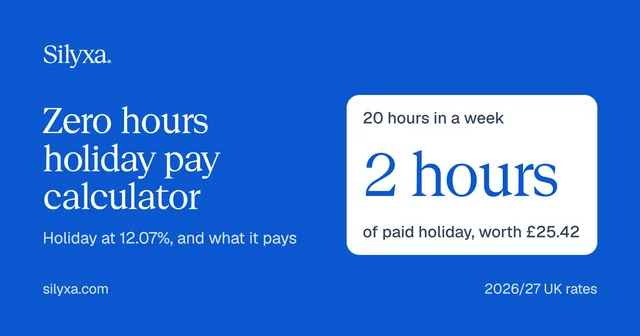
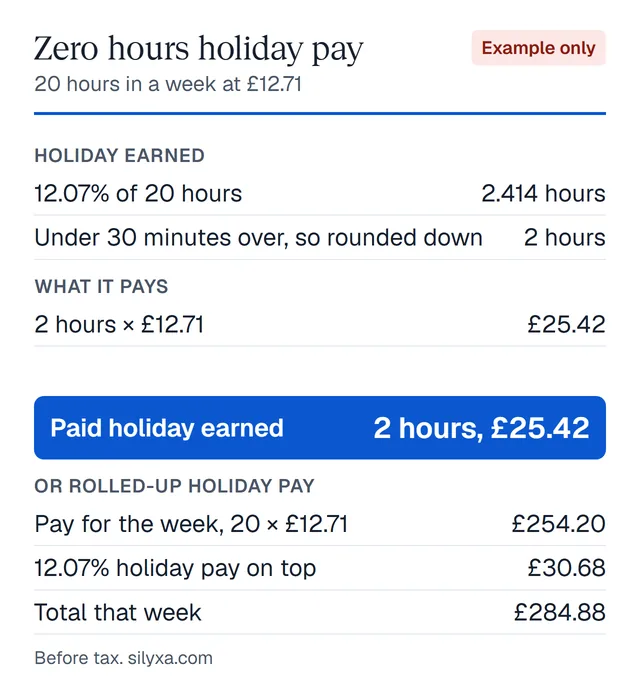
You work 20 hours in a week at £12.71 an hour, £254.20 before tax. 12.07% of 20 hours is 2.414 hours. The part over the whole hours is under 30 minutes, so you earn 2 hours of paid holiday that week. Paid at £12.71 an hour, it is worth £25.42 when you take it.
GOV.UK's own example is a monthly paid worker on 68 hours in June: 8.2076 hours, rounded to 8 hours. The rounding happens every pay period, so 4.142 hours a week earns 0 hours (0.4999) and 4.143 hours earns 1 hour (0.5001).
Holiday earned by hours worked
| Hours worked | 12.07% | Holiday hours | Holiday value | Rolled-up pay |
|---|---|---|---|---|
| 8 hours | 0.9656 | 1 | £12.71 | £12.27 |
| 12 hours | 1.4484 | 1 | £12.71 | £18.41 |
| 16 hours | 1.9312 | 2 | £25.42 | £24.55 |
| 20 hours | 2.414 | 2 | £25.42 | £30.68 |
| 25 hours | 3.0175 | 3 | £38.13 | £38.35 |
| 30 hours | 3.621 | 4 | £50.84 | £46.02 |
| 37.5 hours | 4.5263 | 5 | £63.55 | £57.53 |
| 40 hours | 4.828 | 5 | £63.55 | £61.36 |
How much your holiday pays
Holiday pay is a week's pay for a week off. For irregular hours, regulation 16 turns this into an hourly rate: your average week's pay divided by the average hours you worked in the same weeks. The average is over your last 52 paid weeks. Weeks with no pay, or with any sick or statutory leave, are skipped and earlier weeks used instead, going back no more than 104 weeks. If you have worked less than 52 weeks, use the weeks you have.
Over the same weeks, your total pay divided by your total hours gives the same rate. If you earned £13,000 for 1,000 hours, your holiday rate is £13.00 an hour, so this week's 2 hours of holiday pays £26.00. Enter your totals under More options.
The pay counted includes commission, pay linked to tasks you have to do, pay for seniority or qualifications, and overtime paid regularly in the last 52 weeks. With £45 of regular overtime on 30 hours, the rate for that week is £14.21 an hour, not £12.71.
Rolled-up holiday pay
Your employer can instead pay holiday as you go: 12.07% on top of your pay each pay period, shown on your payslip as holiday pay. On £254.20 that is £30.68, so you are paid £284.88. You still take the time off, but it is unpaid when you take it, because you were paid for it already. Working every week of a year like this, rolled-up pay comes to £1,595.36.
Rolled-up holiday pay is only allowed for irregular hours and part-year workers, for leave years from 1 April 2024. It must be paid at the same time as your pay and shown separately on your payslip. Changing to it may need a change to your contract. While you are on sick or statutory leave, an employer paying this way pays your average holiday pay per pay period from the 52 weeks before.
Sick leave, maternity and other leave
You keep building up holiday while you are on sick leave or statutory leave such as maternity or paternity leave. It is worked out from your average weekly hours in the 52 weeks before the leave: weeks with any sick or statutory leave are skipped, but weeks when you worked no hours still count. 12.07% of that average is what you earn for each week of leave (regulation 15C).
Zero hours holiday pay questions
Do you get holiday pay on a zero hours contract?
Yes. Every worker has the right to 5.6 weeks of paid holiday a year. On a zero hours contract you build it up at 12.07% of the hours you work.
Is 12.07% holiday pay the law?
Yes, for irregular hours and part-year workers in England, Scotland and Wales, for leave years from 1 April 2024. Your contract can give you more, never less. If it gives more than 5.6 weeks of holiday, you build it up faster than 12.07%.
Do I get holiday pay for bank holidays?
Bank holidays are not extra. They come out of the holiday you earn, unless your contract says otherwise.
Can my employer refuse to pay holiday pay?
No. If you have never been paid holiday, speak to your employer first, then the free Acas helpline on 0300 123 1100.
What happens to my holiday when I leave?
Holiday you built up and did not take must be paid in your final pay, at your holiday pay rate (regulation 15E). This does not apply to holiday you were already paid as rolled-up holiday pay. If you took more holiday than you built up, your contract may let your employer take it back. The notice period calculator works out final pay.
I only work in school terms. Does this apply?
Yes, if you have unpaid weeks off in the year you are a part-year worker and build up holiday at 12.07%. If you are paid a salary spread over the year, see the pro rata salary calculator.
Does this apply in Northern Ireland?
Not these exact rules. The rules on this page are in the Working Time Regulations 1998, which cover Great Britain only. Northern Ireland has its own working time rules, and they still give a minimum of 5.6 weeks' paid holiday a year. nidirect says people on irregular hours are entitled to paid time off for every hour they work. See holiday entitlements on nidirect for how it is worked out there.
Is this official?
No. It follows the regulations and GOV.UK's guidance, but your contract or your employer's leave year can change the answer. Acas can help with a dispute.
How this calculator works
Zero hours holiday pay follows regulations 15B, 16 and 16A of the Working Time Regulations 1998, as amended from 1 January 2024, for leave years beginning on or after 1 April 2024 in Great Britain. Holiday accrues at 12.07% of the hours worked in each pay period, rounded each period: a fraction under 30 minutes is dropped and 30 minutes or more is a whole hour, as in GOV.UK's worked example (68 hours gives 8). The hourly holiday rate is a week's pay divided by the average hours worked in the same weeks (regulation 16(1A)); with your totals over your last 52 paid weeks this is total pay divided by total hours, and otherwise this pay period's pay divided by its hours. Rolled-up holiday pay is 12.07% of total pay in the pay period (regulation 16A). Take-home uses 2026/27 tax for a full year paid the same way. We check the method against GOV.UK's worked example, which it reproduces exactly.
Sources
Checked on 22 November 2026 against the 2026/27 tax year.
- Working Time Regulations 1998, regulation 15B: irregular hours and part-year workers
- Working Time Regulations 1998, regulation 15F: who is an irregular hours or part-year worker
- Working Time Regulations 1998, regulation 16: payment for holiday
- Working Time Regulations 1998, regulation 16A: rolled-up holiday pay
- Working Time Regulations 1998, regulation 15C: holiday built up on sick or statutory leave
- Working Time Regulations 1998, regulation 15E: holiday pay when you leave
- GOV.UK Holiday pay and entitlement reforms from 1 January 2024
- GOV.UK Holiday entitlement
- GOV.UK Holiday pay
- nidirect Holiday entitlements (Northern Ireland)
Update history
- 22 November 2026: Added.