
What post-employment notice pay is
Post-employment notice pay (PENP) is the part of a termination payment that HMRC treats as pay for notice you did not work. Since 6 April 2018 it is taxed like salary, with Income Tax and National Insurance, and it never gets the £30,000 tax-free threshold (EIM13505). Only what is left of the award after PENP, together with statutory redundancy pay, can be tax-free.
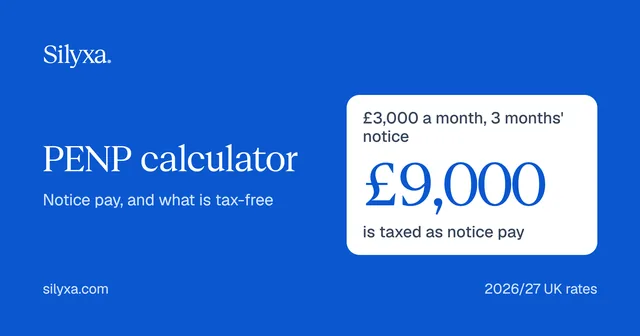
So the question is not just how big your payout is, but how much of it HMRC counts as notice pay. On basic pay of £3,000 a month, with 3 months of notice not worked and a £20,000 award, PENP is £9,000 and £11,000 is tax-free.
How PENP is worked out
HMRC's formula is ((BP × D) ÷ P) − T (EIM13880). If the answer is below nil, PENP is nil, and it can never be more than the termination award.
- BP, basic pay: your pay for the last full pay period before the trigger date, before any salary sacrifice. It leaves out overtime, bonus, commission, gratuities, allowances and benefits such as a company car (EIM13882).
- D, the notice not worked: the calendar days from the end of your last day to the end of your minimum notice. The minimum notice is the longer of your contract and the legal minimum, counted from the day notice is given, or from your last day if none was given (EIM13890, EIM13898).
- P, the pay period: 7 days for weekly pay, 14 for fortnightly, 28 for every 4 weeks. Paid in 12 equal monthly payments, P is 1 with D in months when your notice is in whole months, and 30.42 when it isn't (EIM13886).
- T, pay in lieu already taxed: contractual pay in lieu of notice and other termination payments taxed as pay, but not holiday pay or a termination bonus (EIM13896).
HMRC's worked example
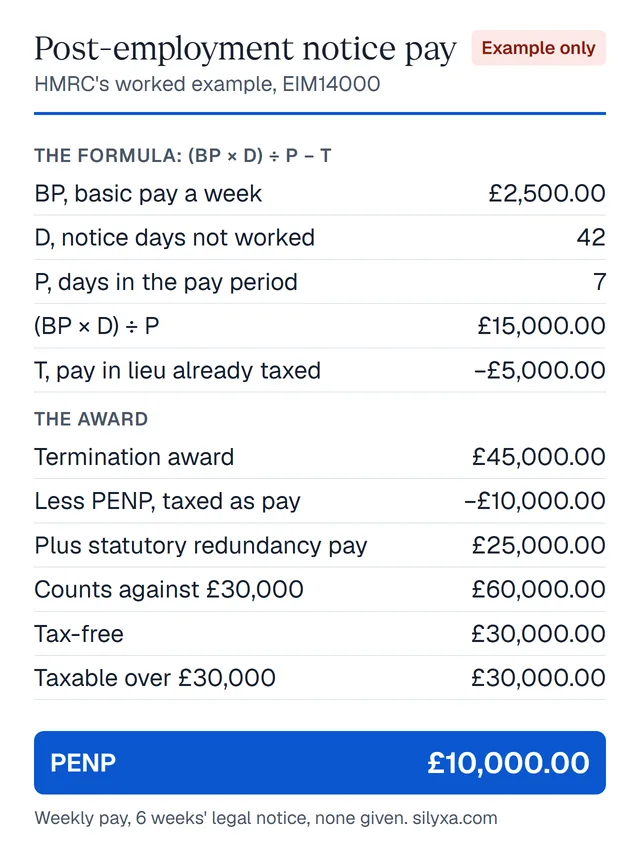
HMRC's example at EIM14000 is an employee on £2,500 a week whose contract gives 2 weeks' notice, but who is entitled to 6 weeks by law and gets none. The legal minimum is longer, so D is 42 days; weekly pay makes P 7; and a contractual pay in lieu of £5,000 is T. PENP is (£2,500 × 42) ÷ 7 − £5,000 = £10,000.
The £45,000 compensation less PENP leaves £35,000. Add the £25,000 statutory redundancy pay and £60,000 counts against the threshold: £30,000 tax-free and £30,000 taxable. Choose HMRC example above to see the same figures.
Monthly pay: whole months or 30.42
Most people paid monthly with no notice worked get the simple rule: a month's basic pay for each month of notice. Work part of your notice and the rest is rarely a whole number of months, so D becomes calendar days and P becomes 30.42. Given 3 months' notice on 20 October 2026 and leaving on 5 November 2026 leaves 76 days, and PENP of £7,495.07 on £3,000 a month.
When your contract notice is shorter than the law
The legal minimum is 1 week after a month in the job, then 1 week for each complete year from 2 years, up to 12 weeks (Employment Rights Act 1996, section 86). HMRC uses whichever is longer. With 1 week in the contract but 6 complete years, the minimum is 6 weeks, so D is 42 days, not 7. The notice period calculator works out your legal minimum and the date it ends.
PILON and PENP
Pay in lieu of notice (PILON) paid under your contract is already taxed as pay, and it is T in the formula. If it covers your notice, PENP is nil: on these figures, pay in lieu of £9,000 gives PENP of £0, and the whole £20,000 award goes to the threshold. That is why a settlement agreement can say PENP is nil. If no PILON is paid, PENP still applies: part of the award is taxed as the notice pay you didn't get.
PENP questions
Is PENP taxable?
Yes. It is taxed as earnings, with Income Tax and Class 1 National Insurance, and the £30,000 threshold does not apply to it.
Is statutory redundancy pay part of PENP?
No. Statutory redundancy pay is not a relevant termination award, so it is never PENP. It counts towards the £30,000 threshold.
Is there a GOV.UK PENP calculator?
No. GOV.UK publishes the formula in HMRC's Employment Income Manual, and this calculator follows it, checked against HMRC's own example.
Do NHS staff use different PENP rules?
No. PENP is tax law, so it is the same for NHS and other public sector staff. Your notice comes from your contract and the legal minimum.
What tax is paid on the amount over £30,000?
Income Tax at your rate, but no employee National Insurance. Your employer pays Class 1A National Insurance on it.
Is this official?
No. It follows HMRC's manual, but your employer's payroll decides how your payment is taxed. For a large or complicated package, get advice.
How this calculator works
Post-employment notice pay follows section 402D of the Income Tax (Earnings and Pensions) Act 2003 as HMRC's Employment Income Manual explains it: ((BP × D) ÷ P) − T, nil if negative and never more than the termination award (EIM13880). BP is basic pay for the last pay period before the trigger date, before salary sacrifice (EIM13882). D is the calendar days from the last day of work to the end of the minimum notice, the longer of the contract and the legal minimum in section 86 of the Employment Rights Act 1996, counted from the day notice is given or, with none, the last day (EIM13890, EIM13898). P is 7, 14 or 28 days for weekly pay; for 12 equal monthly payments it is 1 with D in months when the notice is in whole months, and 30.42 otherwise (EIM13886). The rest of the award and statutory redundancy pay share the £30,000 threshold (EIM13505), checked against HMRC's example at EIM14000. Tax is an estimate at the marginal rate you choose.
Sources
Checked on 20 November 2026 against the 2026/27 tax year.
- HMRC manual EIM13880: post-employment notice pay formula
- HMRC manual EIM13882: PENP formula, how to calculate 'BP'
- HMRC manual EIM13886: PENP formula, how to calculate 'P'
- HMRC manual EIM13890: PENP formula, how to calculate 'D'
- HMRC manual EIM13896: PENP formula, how to calculate 'T'
- HMRC manual EIM13898: PENP, meaning of terms
- HMRC manual EIM14000: relevant termination awards, worked example
- HMRC manual EIM13505: the £30,000 threshold
- Employment Rights Act 1996, section 86: minimum notice
Update history
- 23 November 2026: National Insurance on PENP and pay in lieu is now worked out on the pay period it is paid in, with one period of your usual pay: 8% up to the upper earnings limit, then 2%. Added a student loan option, worked out the same way, and a warning when the package could take you into the higher rate.
- 21 November 2026: Simpler form: the notice length and unit sit on one line, the notice date replaces the separate notice switch (leave it blank if you left at once), and redundancy pay and pay in lieu already taxed moved under More options. No change to the method.
- 20 November 2026: Added.