
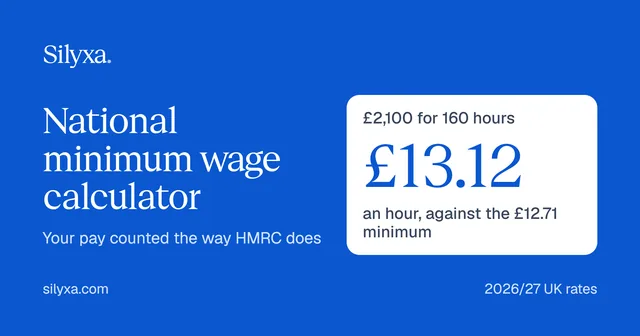
National Minimum Wage rates for 2026/27 and April 2027
From 1 April 2026 the National Living Wage is £12.71 an hour for workers aged 21 and over. On 1 April 2027 it rises to £13.21. The National Minimum Wage is lower for younger workers and apprentices. The rates are the same in England, Scotland, Wales and Northern Ireland, and in London.
| Age | April 2025 | April 2026 | April 2027 | Rise in 2027 |
|---|---|---|---|---|
| 21 and over | £12.21 | £12.71 | £13.21 | 50p, 3.9% |
| 18 to 20 | £10.00 | £10.85 | £11.27 | 42p, 3.9% |
| Under 18 | £7.55 | £8.00 | £8.31 | 31p, 3.9% |
| Apprentice | £7.55 | £8.00 | £8.31 | 31p, 3.9% |
Apprentices get the apprentice rate if they are under 19, or 19 or over and in the first year of the apprenticeship. After the first year, an apprentice aged 19 or over gets the rate for their age. An apprentice aged 20 in the first year on £8.50 an hour gets more than the £8.00 minimum. The Real Living Wage is a separate, voluntary rate that some employers choose to pay; it is not the legal minimum.
How the minimum wage is checked
Your pay meets the minimum wage when the pay that counts, divided by all the hours you worked in the pay period, is at least the rate for your age. HMRC checks each pay period on its own, the time your pay covers, which is never longer than a calendar month. Your annual salary is not checked as a whole.
- Start with your pay before tax for the pay period.
- Take out pay that doesn't count: tips and service charges, the extra part of overtime or shift pay, allowances that aren't built into your pay, expense refunds and benefits in kind.
- Take off deductions that reduce minimum wage pay: salary sacrifice, and money you pay or have deducted for things the job needs, such as uniform, tools or required training.
- Divide by every hour you worked in the period, paid or unpaid.
- Compare with your rate. If it is lower, your employer owes the difference.
A worked example
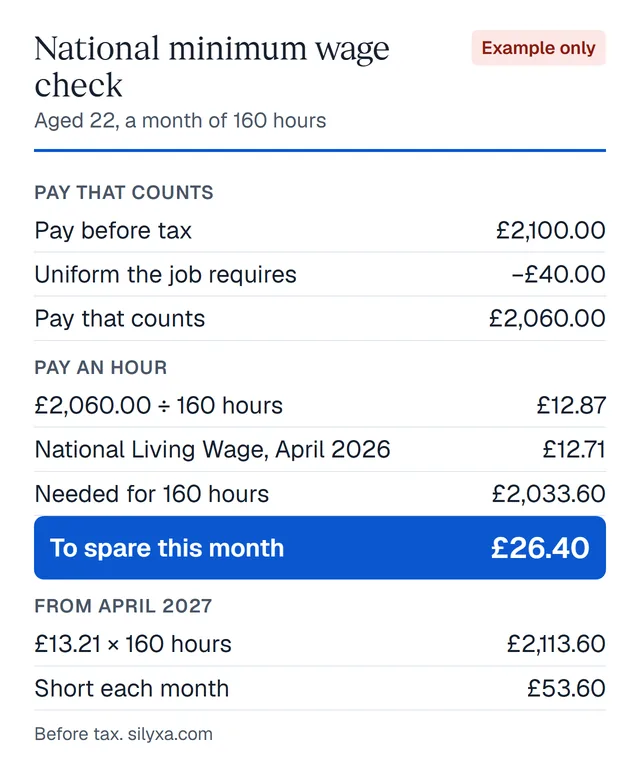
You are 22, paid £2,100 for a month in which you work 160 hours, and you buy a £40 uniform your employer requires. The uniform comes off, so the pay that counts is £2,060.00. £2,060.00 ÷ 160 hours = £12.87 an hour, above the £12.71 minimum, with £26.40 to spare. Without the uniform it would be £13.12 an hour.
The same pay falls short from April 2027: 160 hours at £13.21 needs £2,113.60, so your employer would have to find another £53.60 a month. The April 2027 tab shows this for your own pay.
Unpaid hours and salaried workers
Every hour you work counts, whether or not you are paid for it: staying late to close, time at work waiting to be given work, training, and travel between clients or sites during the working day. Rest breaks and travel between home and work don't count. Add 20 unpaid hours to the example month, without the uniform, and the same £2,100 works out at £11.66 an hour, £187.80 short.
On a salary, GOV.UK calls this salaried hours work. Your contract sets your basic hours for the year, and they are divided equally across your paydays, so a month with more working days doesn't change the check. Weekly hours × 52 is one way to get the yearly total; GOV.UK says employers may also use 52.14 or 52.18 weeks if they can show how. Hours over your basic hours count once the year's basic hours are used up, so regular unpaid overtime can put the last months of the year below the minimum.
Is a salary of £25,000 below minimum wage?
It depends on your hours. At £12.71 an hour:
- 35 hours a week: £13.73 an hour, above the £12.71 minimum.
- 37.5 hours a week: £12.82 an hour, above the £12.71 minimum, but below £13.21 from April 2027.
- 40 hours a week: £12.01 an hour, below the £12.71 minimum, £119.74 short each month.
So £25,000 is at or above the minimum today for 35 or 37.5 hours a week, but not for 40.
Minimum wage pay by hours a week
What the National Living Wage of £12.71 adds up to for common hours, and the yearly pay from April 2027. Take-home is for England, Wales and Northern Ireland, with no pension or student loan.
| Hours a week | A month | A year | Take-home a month | A year from April 2027 |
|---|---|---|---|---|
| 16 hours | £881.23 | £10,575 | £881.23 | £10,991 |
| 20 hours | £1,101.53 | £13,218 | £1,086.60 | £13,738 |
| 25 hours | £1,376.92 | £16,523 | £1,284.89 | £17,173 |
| 30 hours | £1,652.30 | £19,828 | £1,483.16 | £20,608 |
| 35 hours | £1,927.68 | £23,132 | £1,681.43 | £24,042 |
| 37.5 hours | £2,065.38 | £24,785 | £1,780.57 | £25,760 |
| 40 hours | £2,203.07 | £26,437 | £1,879.71 | £27,477 |
What counts as pay, and what reduces it
| Item | For the minimum wage |
|---|---|
| Basic pay, bonus, commission, performance pay | Counts |
| Tips, service charges, cover charges | Doesn't count, even through payroll |
| Overtime, night, weekend or bank holiday premiums | Only the basic rate part counts |
| Allowances, such as London weighting or on-call pay | Don't count unless built into your normal pay |
| Salary sacrifice (cycle to work, car, pension, childcare vouchers) | Reduces your pay |
| Uniform, tools or training the job requires | Reduces your pay, if you pay or it is deducted |
| Accommodation from your employer | A charge above the offset reduces it; free accommodation adds the offset |
| Income Tax, National Insurance, student loan | Don't reduce it |
| Your pension contribution taken from pay | Doesn't reduce it |
| Till shortage you are liable for under your contract | Doesn't reduce it |
GOV.UK's own example: a worker aged 30 is paid £493 for 40 hours, 30 at a basic £12.10 and 10 of overtime at £13.00. That looks like £12.33 an hour, but the £9 overtime premium doesn't count, so it is £12.10, below the £12.21 rate for 2025/26.
Salary sacrifice, cycle to work and pensions
Salary sacrifice reduces the pay that counts, so a scheme must not take you below the minimum wage. In the example, a £150 sacrifice each month gives £12.18 an hour, £83.60 short. The April 2027 tab shows the most a sacrifice could be now and from April 2027 with your hours, which matters if you sign up to a cycle or car scheme that runs past April.
A pension contribution taken from your pay in the normal way, not by sacrifice, doesn't reduce your pay for the minimum wage. It only lowers your take-home.
Accommodation
Accommodation is the only benefit that can count towards the minimum wage. If it is free, £11.10 a day (the accommodation offset) is added to your pay. If you are charged more than that, the extra reduces your pay. A charge at or below the offset makes no difference. The offset rises to £11.53 a day from April 2027.
Back pay at today's rate
Minimum wage arrears are paid at today's rate, not the rate when you were underpaid (section 17 of the National Minimum Wage Act 1998). The amount is the higher of the shortfall and the shortfall divided by the old rate, times today's rate for you.
Say you were 22 and paid £1,900 for 160 hours in a month in 2025/26. That is £11.87 an hour against £12.21, so the shortfall is £53.60. At today's £12.71, £53.60 ÷ £12.21 × £12.71 = £55.79 owed for that month. Choose the year under More options, and enter how many pay periods were the same.
HMRC can order an employer to pay arrears and a penalty of up to 200% of them, up to £20,000 for each worker.
Minimum wage rates in past years
| Year | National Living Wage | 18 to 20 | Under 18 | Apprentice |
|---|---|---|---|---|
| April 2025 to March 2026 | £12.21 | £10.00 | £7.55 | £7.55 |
| April 2024 to March 2025 | £11.44 | £8.60 | £6.40 | £6.40 |
| April 2023 to March 2024 | £10.42 | £7.49 | £5.28 | £5.28 |
| April 2022 to March 2023 | £9.50 | £6.83 | £4.81 | £4.81 |
| April 2021 to March 2022 | £8.91 | £6.56 | £4.62 | £4.30 |
| April 2020 to March 2021 | £8.72 | £6.45 | £4.55 | £4.15 |
| April 2019 to March 2020 | £8.21 | £6.15 | £4.35 | £3.90 |
From April 2021 to March 2024 there was also a rate for ages 21 to 22 (£10.18 from April 2023, £9.18 from April 2022, £8.36 from April 2021), and before that for ages 21 to 24 (£8.20 from April 2020, £7.70 from April 2019).
If you are paid less than the minimum wage
- Check a few payslips and your hours with this calculator, and keep a note of the hours you work.
- Ask your employer or payroll to put it right. You have the right to see their minimum wage records about you.
- Call the Acas helpline on 0300 123 1100 for free advice.
- Complain to HMRC through GOV.UK pay and work rights. You can do this for someone else, too.
National minimum wage questions
What is the minimum wage in April 2027?
£13.21 an hour for ages 21 and over, £11.27 for 18 to 20, and £8.31 for under 18 and apprentices, from 1 April 2027.
How much is minimum wage a month for 40 hours a week?
£2,203.07 before tax at £12.71 an hour, about £1,879.71 after tax in England, Wales and Northern Ireland with no pension.
Does unpaid overtime count for the minimum wage?
Yes. All the hours you work count, so unpaid time lowers your pay an hour. On a salary, extra hours count once your basic hours for the year are used up.
Does on-call time count?
Yes, if you must be available at or near your workplace. Time on call at home doesn't count, and sleep-in shifts have their own rules.
Can my employer make me pay for my uniform?
Only if your pay stays at or above the minimum wage after it. A uniform or work wear the job requires reduces your pay for the minimum wage, whether it is deducted or you buy it yourself, unless your employer pays you back.
Can salary sacrifice take me below the minimum wage?
No. A sacrifice for a bike, car, pension or anything else must leave your pay at or above the minimum wage.
Do tips count towards the minimum wage?
No. Tips, service charges and cover charges never count, even if they are paid through payroll.
Is the minimum wage higher in London or Scotland?
No. The legal minimum is the same across the UK. Scottish Income Tax only changes your take-home.
Does the minimum wage apply if I'm self-employed?
No, it is for workers and employees. If you work for yourself, see the self-employed tax calculator.
What was the minimum wage in 2020?
From April 2020 it was £8.72 for ages 25 and over and £8.20 for 21 to 24.
Is this official?
No. It follows GOV.UK's guidance and the law, but it can't decide disputed cases such as sleep-in shifts or piece work. HMRC and Acas can help with those.
How this calculator works
National Minimum Wage follows GOV.UK's guidance on calculating the minimum wage for one pay reference period, never longer than a calendar month. Pay that counts is pay before tax, less tips and service charges, the premium part of overtime and shift pay, and allowances you enter as not counting, less salary sacrifice and money paid or deducted for things the job requires, adjusted for accommodation: free accommodation adds the daily offset, and a charge above it takes off the excess. It is divided by all the hours worked in the period, paid and unpaid, and compared with the rate for the worker's age, or the apprentice rate for an apprentice under 19 or in the first year, from April 2019 to April 2027. On a salary, the hours are weekly hours × 52 ÷ 12 a month, one of the ways GOV.UK accepts for salaried hours work. Back pay for a past year follows section 17 of the National Minimum Wage Act 1998: the higher of the shortfall and the shortfall divided by the rate then, times today's rate for the same worker. The hourly figure is shown rounded down to the penny, as GOV.UK does. Take-home uses the shared engine with 2026/27 tax for a full year paid the same way. We check the method against GOV.UK's own worked examples for overtime and shift premiums and for accommodation, which it reproduces exactly.
Sources
Checked on 21 November 2026 against the 2026/27 tax year.
- GOV.UK National Minimum Wage and National Living Wage rates
- GOV.UK Minimum wage rates for 2027 (Low Pay Commission, 28 October 2026)
- GOV.UK Calculating the minimum wage: what counts as pay and deductions
- GOV.UK Calculating the minimum wage: working hours, including salaried hours work
- GOV.UK National Minimum Wage and Living Wage: accommodation
- National Minimum Wage Act 1998, section 17: arrears
- GOV.UK Calculating the minimum wage: enforcement, arrears and penalties
- GOV.UK Pay and work rights helpline and complaints
Update history
- 23 November 2026: Pension now starts at 0% until you enter yours, so the take-home figures no longer assume a pension you may not pay.
- 21 November 2026: Added.