
How pay works on a shift pattern
On a rotating pattern you work a fixed cycle of days on and days off, so your hours a week are an average, not a fixed number. Your average week is the paid hours in one cycle, scaled to 7 days. On 4 on 4 off with 12-hour shifts and a 30-minute unpaid break, that is 40.25 paid hours a week: 11.5 hours, times 4 shifts, divided by 8 days, times 7.
At £14.00 an hour, starting on 1 April 2026, that is 184 shifts and £29,624 before tax from April 2026 to March 2027, about £2,071 a month after Income Tax and National Insurance on the standard tax code.
| Pattern | Days on | Hours a week | Shifts a year | Shifts a month |
|---|---|---|---|---|
| 4 on 4 off | 4 in 8 | 40.25 | 184 | 14 to 16 |
| 3 on 3 off | 3 in 6 | 40.25 | 183 | 15 to 16 |
| 2 on 2 off | 2 in 4 | 40.25 | 183 | 14 to 16 |
| 5 on 3 off | 5 in 8 | 50.31 | 230 | 18 to 20 |
| 4 on 3 off | 4 in 7 | 46 | 209 | 16 to 19 |
| 2-2-3 (Pitman) | 7 in 14 | 40.25 | 183 | 14 to 16 |
Why some months pay more on a 4 on 4 off rota
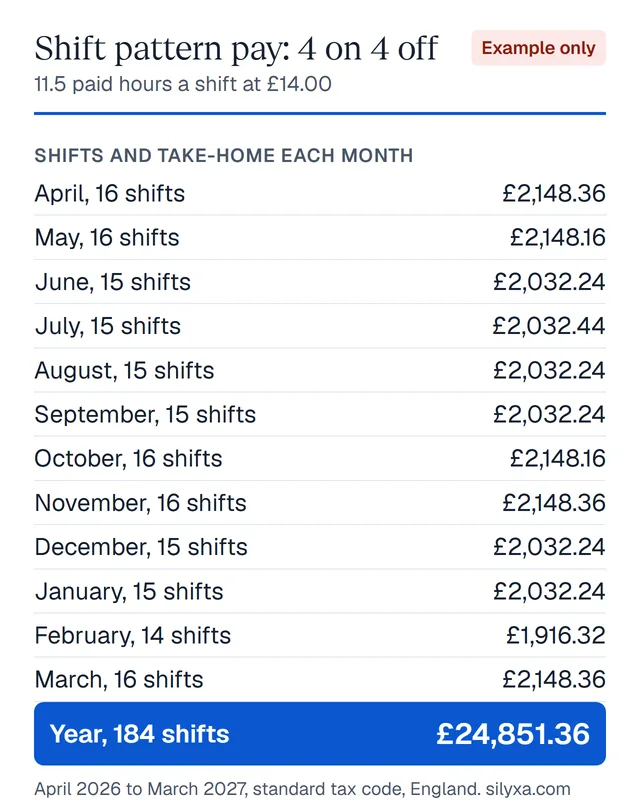
An 8-day cycle does not fit evenly into calendar months, so the number of shifts in a month moves between 14 and 16. If you are paid for the shifts you work, a month with 16 shifts pays £2,576 before tax at £14.00 an hour and one with 14 shifts pays £2,254. Your average pay is the same; the timing is not.
Payroll works out Income Tax to date each month (cumulative PAYE), so a bigger month is taxed on what you have earned so far in the tax year, not as if every month were that size. The calculator does the same, so each month's take-home matches what a payslip would show on the standard tax code. If your employer pays a salary instead, you get the same pay every month and the calendar only changes your hours: choose Same each month.
Are breaks paid on a 12-hour shift?
Not by law. Regulation 12 of the Working Time Regulations 1998 gives a worker an uninterrupted rest break of at least 20 minutes when the working day is more than 6 hours (30 minutes over 4.5 hours for workers under 18). GOV.UK says the break does not have to be paid: it depends on the contract. A 30-minute unpaid break on every 12-hour shift is 11.5 paid hours, about 4% less than 12, which is why a quick hours-times-rate sum overstates shift pay. Tick Break is paid if your contract pays it.
Night, weekend and bank holiday pay
There is no legal extra rate for nights, weekends or bank holidays. GOV.UK says the minimum wage applies to night workers but there is no higher night rate, and the minimum wage for workers aged 21 and over is £12.71 an hour from April 2026, day or night. The national minimum wage calculator checks your average pay against it. Extras come only from your contract, as a percentage on top of your hourly rate. Enter yours under Extras and contract. Where several match one shift, such as a Saturday night, the calculator pays the highest one once: check how your contract treats them. Bank holidays follow GOV.UK's dates for England and Wales, Scotland or Northern Ireland.
Does my shift pattern give my contract hours?
Not always. A common complaint is a pattern that averages fewer hours than the contract. On 4 on 4 off with 11-hour shifts and no unpaid break, the average week is 38.5 hours, so a 40-hour contract is 1.5 hours short every week, about 78 hours over a year. Employers handle that gap in different ways: extra shifts, a lower salary, or hours owed. Enter your contract hours and the calculator shows the gap both ways.
How a week's pay is worked out on a rota
For holiday pay, notice pay and similar, GOV.UK says a week's pay on shift or rota work is your average hours at your average rate over 12 weeks. Its worked example is 3 on 3 off with 9-hour shifts from a Monday, £9.00 an hour on weekdays and £11.00 at weekends. We recomputed it day by day with the same engine as the calculator: 42 shifts in 12 weeks, 30 on weekdays and 12 at weekends, 31.5 hours a week and £301.50 a week, exactly GOV.UK's figures. Its example rates are below today's minimum wage, so use them for the method only.
Shift pattern pay questions
How many hours a week is 4 on 4 off?
With 12-hour shifts, 42 hours a week on average if your breaks are paid, and 40.25 hours with a 30-minute unpaid break.
How many shifts a year is 4 on 4 off?
About 182, half the days in the year. From 1 April 2026 to 31 March 2027 it is 184, depending on where the year starts in your cycle.
How many hours a month is 4 on 4 off?
174.4 paid hours a month on average with 12-hour shifts and a 30-minute unpaid break, but a real month has between 14 and 16 shifts.
Do I have to be paid more for night shifts?
No. The law sets no higher night rate; only your contract can. Every paid hour must still average at least the minimum wage.
Do I get extra pay for working a bank holiday?
Only if your contract says so. There is no legal right to a higher rate for working one.
Is this official?
No. It follows GOV.UK and the Working Time Regulations, but your contract and payroll decide your pay.
How this calculator works
Shift pattern pay lays your pattern over every day from 1 April 2026 to 31 March 2027, starting from a first day on that you choose, and counts the shifts in each calendar month. Each shift pays its paid hours (the shift length less the break, unless your break is paid; GOV.UK's rest breaks guidance says a break need not be paid) at your hourly rate, plus the highest of the night, weekend or bank holiday extras your contract gives, never several at once. Weekends and bank holidays go by the day a shift starts, using GOV.UK's bank holiday dates for England and Wales, Scotland or Northern Ireland. Paid for shifts worked, each month's pay is taxed by cumulative PAYE on the standard code, Income Tax to date less Income Tax already paid, with National Insurance and student loan for that month; on a salary the year's pay is split into 12 equal months. The average week is the paid hours of one cycle scaled to 7 days, compared with your contract hours. We check the method against GOV.UK's own shift pay example (3 on 3 off, 42 shifts in 12 weeks, £301.50 a week), which it reproduces exactly. Holiday, sickness, overtime and pay in arrears aren't modelled.
Sources
Checked on 19 November 2026 against the 2026/27 tax year.
- GOV.UK Understanding your pay: pay calculations if you work shifts or get bonuses
- GOV.UK Rest breaks at work
- Working Time Regulations 1998, regulation 12
- GOV.UK Night working hours
- GOV.UK National Minimum Wage and National Living Wage rates
- GOV.UK UK bank holidays
Update history
- 23 November 2026: Added 4 days, 4 off, 4 nights, 4 off, a salary box for pay that is the same each month (the minimum wage check then uses that salary), and the postgraduate loan.
- 19 November 2026: Added.