
How a second job is taxed
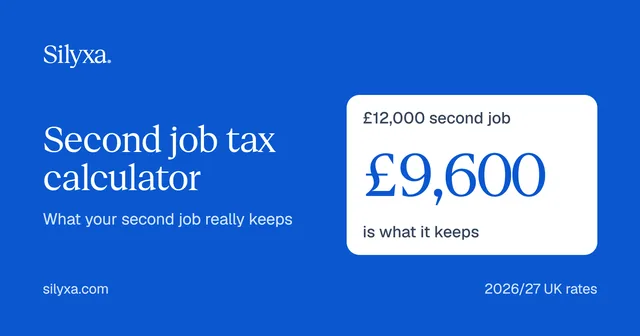
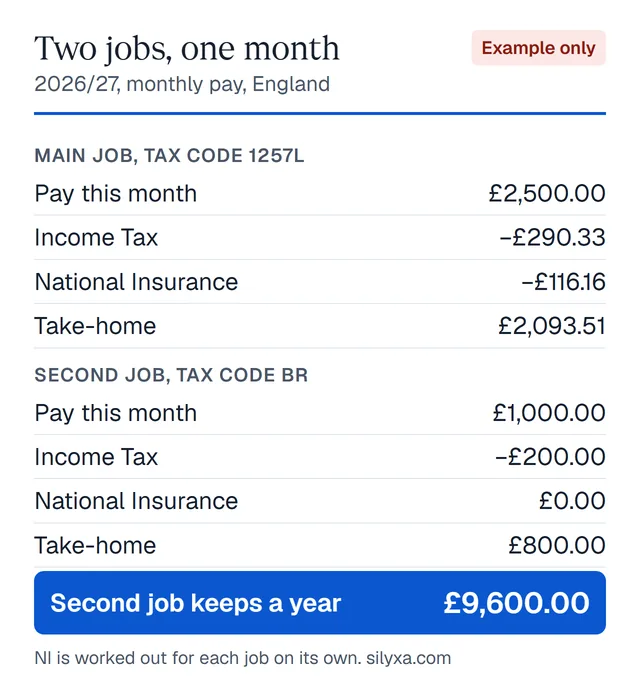
You get one Personal Allowance, £12,570 in 2026/27, however many jobs you have. HMRC usually puts it all on the job that pays most, so your second job gets a code like BR, which taxes all of its pay at 20% from the first pound (GOV.UK, how tax works with more than one job). The second job is not taxed more than the first; it simply has no allowance left to use. On £30,000 and £12,000, the codes are 1257L and BR, and the £12,000 job keeps £9,600.00 a year.
| Main + second job | Tax codes | Second job keeps | Share kept | Year end: back (+) or owed (−) |
|---|---|---|---|---|
| £20,000 + £8,000 | 1257L / BR | £6,400.00 | 80.0% | £0.00 |
| £30,000 + £12,000 | 1257L / BR | £9,600.00 | 80.0% | £0.00 |
| £40,000 + £8,000 | 1257L / BR | £6,400.00 | 80.0% | £0.00 |
| £45,000 + £10,000 | 1257L / BR | £7,054.00 | 70.5% | −£948.00 |
| £60,000 + £15,000 | 1257L / D0 | £8,806.08 | 58.7% | £0.00 |
Second job tax codes: BR, D0 and D1
BR taxes everything at the basic rate, 20%. If your main job already uses up the basic rate band, the second job should get D0, which taxes it all at 40%, and D1, at 45%, applies when the main job alone is already over the additional rate line. In Scotland the codes start with S (SBR, SD0 to SD3) and follow the Scottish bands; in Wales they start with C. If the code on your second job doesn't match your total pay, the tax taken is wrong and the gap shows up after the year ends. Type both codes from your payslips under More options to check them. Not sure of a code? Leave the box blank and the calculator uses the code HMRC usually gives; your codes are also in the PAYE section of your HMRC online account and the HMRC app.
Will I owe tax with two jobs?
You can if the second job takes you into the higher rate on a BR code. On £45,000 and £10,000, part of the second job's pay is over the £50,270 line, so it should be taxed at 40%, but BR takes only 20%. That leaves about £948.00 owed for the year. HMRC works this out after the year ends and usually sends a P800 tax calculation showing whether you are due a refund or owe tax.
Two small jobs: splitting your Personal Allowance
If your main job pays less than the allowance, a BR code on the other job wastes part of it. On £8,000 and £6,000, the usual codes take £914.00 more tax than is due for the year. You can ask HMRC to split your allowance between the jobs, for example 800L and 457L, so each job uses some of it and the tax taken is close to right month by month. To see your main job on its own, use the monthly take home pay calculator.
National Insurance and student loan with two jobs
National Insurance is worked out for each job on its own (HMRC National Insurance Manual NIM10003), so each job gets its own threshold of £1,048 a month. On £30,000 and £12,000, the second job pays no NI, as £1,000 a month is under the threshold, and you pay £960.00 less a year than on one job paying the same total. This does not apply if the employers are connected and carry on business together (NIM10004).
Student loan works the same way: each employer takes it only if your pay from that job is over the threshold, not on your combined income (GOV.UK). On Plan 2 with the same two jobs, £55.35 a year comes from the main job and £0.00 from the second.
Second job tax questions
Is a second job taxed at 20%?
Usually, on a BR code, because your Personal Allowance is on your main job. If your main job alone uses up the basic rate band (over £50,270 in England, Wales and Northern Ireland), the right code for the second job is D0, at 40%. If only the two together go over, BR takes too little and the gap shows up after the year ends.
Do I pay more tax on a second job?
No. Your tax is worked out on your total pay for the year, at the same rates as one job. The second job just has no allowance left, so all of its pay is taxed.
Do I need to tell HMRC about a second job?
Fill in the starter checklist for your new employer and say that you already have another job, so the right code is used from your first pay. You can see which job uses your Personal Allowance, and your tax codes, in the PAYE section of your HMRC online account or the HMRC app, and contact HMRC to ask whether your allowance can be split.
Do I pay National Insurance on both jobs?
Each job is checked on its own. If one pays less than £1,048 a month, it has no employee NI, even if your total is higher.
Can I defer National Insurance with two jobs?
Yes, if one job pays £967 a week or more and the other £242 or more over the tax year (GOV.UK, Defer your National Insurance). The second job then takes 2% instead of 8% on its pay between £242 and £967 a week. On £60,000 and £15,000, that is about £145.44 less taken during the year, and HMRC checks your total after the year ends. For 2026/27, HMRC must receive form CA72A by 14 February 2027.
Is this official?
No. It follows GOV.UK and HMRC's rules, but HMRC sets your tax codes and works out the year in the end.
How this calculator works
Second job tax works out each job on its own tax code with cumulative PAYE, as payroll does: by default the Personal Allowance goes on the main job and the second job gets BR, D0 or D1 (SBR to SD3 in Scotland), as GOV.UK describes for more than one job. It then works out the Income Tax due on both jobs together and shows the difference as the likely refund or bill after the year ends. National Insurance is worked out for each job on its own (National Insurance Manual NIM10003), and student loan is taken only from a job paid over the threshold, not on your combined pay. What the second job keeps is its pay less the extra tax it causes, its own NI and its own loan repayment. It assumes a full year in both jobs, paid monthly, and employers that are not connected (NIM10004). When one job pays at least the weekly upper limit and the other at least the weekly threshold, it also shows the NI deferral GOV.UK allows: the lower-paid job at 2% instead of 8% between the two limits.
Sources
Checked on 19 November 2026 against the 2026/27 tax year.
- GOV.UK How tax works if you have more than one job
- GOV.UK What your tax code means
- HMRC National Insurance Manual NIM10003: earnings from different employers
- HMRC National Insurance Manual NIM10004: employers carrying on business in association
- GOV.UK Defer your National Insurance
- GOV.UK Repaying your student loan, what you pay
- GOV.UK Income Tax rates and allowances
Update history
- 23 November 2026: The second job pay can now be entered a year, a month, a week or an hour.
- 15 November 2026: Added.