
How notice periods work
Your contract sets your notice, but it can't be shorter than the legal minimum in section 86 of the Employment Rights Act 1996. Once you've worked somewhere for a month, you must give at least 1 week's notice to resign. Your employer must give you at least 1 week, rising to 1 week for each complete year from 2 years, up to 12 weeks.
| Complete years in the job | Your employer gives at least | You give at least |
|---|---|---|
| Under 1 year | 1 week | 1 week |
| 1 year | 1 week | 1 week |
| 2 years | 2 weeks | 1 week |
| 3 years | 3 weeks | 1 week |
| 5 years | 5 weeks | 1 week |
| 8 years | 8 weeks | 1 week |
| 10 years | 10 weeks | 1 week |
| 12 years | 12 weeks | 1 week |
| 20 years | 12 weeks | 1 week |
Unless your contract says otherwise, notice starts the day after you resign, or the day after your employer tells you in person. Notice in a letter starts once you've had reasonable time to read it (Acas). A month's notice given on 12 November 2026 ends on 12 December 2026.
Final pay when you leave a job
Your last payslip usually has three parts: salary up to your last day, pay for holiday you've earned but not taken, and pay in lieu of notice if you don't work it. Tax on it is worked out on your pay for the whole tax year so far, so a short final month can mean less tax, or tax back.
| Yearly pay | Normal month | Salary in the last month | Holiday pay | Final payslip |
|---|---|---|---|---|
| £25,000 | £1,793.51 | £806.45 | £821.39 | £1,465.45 |
| £30,000 | £2,093.51 | £967.74 | £985.67 | £1,699.78 |
| £40,000 | £2,693.51 | £1,290.32 | £1,314.23 | £2,168.83 |
| £60,000 | £3,780.17 | £1,935.48 | £1,971.34 | £3,162.85 |
Holiday pay when you leave
When you leave part-way through your leave year, your employer must pay you for statutory holiday you've earned but not taken, even if you're dismissed for gross misconduct (GOV.UK). Regulation 14 of the Working Time Regulations 1998 works it out as (A × B) − C: your yearly leave (A), times the share of the leave year gone by your leaving date (B), less the leave you've taken (C). Each day is paid at a day's pay.
For example, with 28 days a year and a leave year from 1 January, leaving on 12 December 2026 means 346 of 365 days have gone, so you've earned 26.5 days. With 18 taken, you're owed 8.5 days: £985.67 on £30,000 a year.
Holiday keeps building up through your notice, including garden leave. Statutory leave is 5.6 weeks a year, at most 28 days, and bank holidays can count towards it. Pay for extra days in your contract depends on its terms.
Can my employer take back holiday I took ahead?
Only if you agreed to it beforehand in writing, usually in your contract (Working Time Regulations, regulation 14(4); GOV.UK). Without that, they must not take money from your final pay for it. With 30 days taken and 26.5 earned, 3.5 days were taken ahead: £398.95 could come off, but only with that agreement.
Pay in lieu of notice and how it's taxed
Your employer can pay you instead of you working your notice only if your contract allows it, or you agree. Your job then ends straight away, and you must get full pay for the notice period (Acas). It is taxed in full, like wages: HMRC calls it post-employment notice pay. On a monthly salary, notice in whole months is a month's basic pay for each month; other notice is a month's pay × the days not worked ÷ 30.42, the average days in a month (EIM13880 and EIM13886). The £30,000 tax-free amount for termination payments doesn't apply to it.
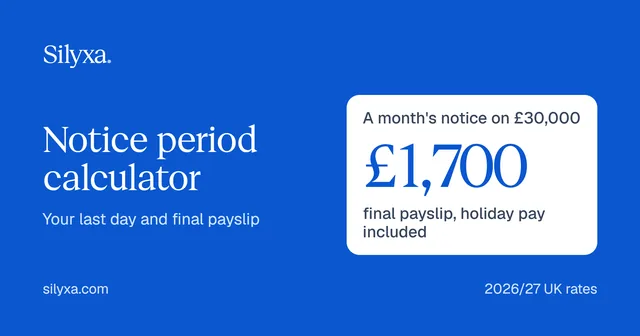
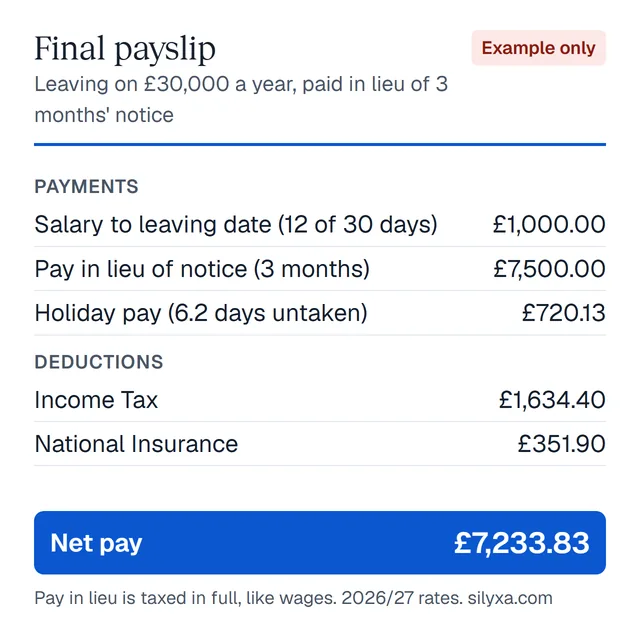
Paid in lieu of 3 months' notice on 12 November 2026, on £30,000 a year, you'd get £7,500.00 for the 3 months, plus £1,000.00 of salary and £720.13 of holiday pay. After tax and National Insurance, that final payslip is about £7,233.83.
Garden leave
On garden leave your employer tells you not to work some or all of your notice. You're still employed, and you must be paid as usual, including the benefits in your contract (Acas). Your last day is the end of your notice, and holiday keeps building up until then.
Holiday pay paid after your P45
If your holiday pay comes after your P45, your employer taxes it with code 0T on a month 1 basis, so none of your tax-free allowance is used. National Insurance treats it as one week's pay (GOV.UK: What to do when an employee leaves). On £985.67, that's £197.00 of tax and £58.37 of National Insurance. Tax overpaid over the year can be claimed back from HMRC.
Notice period questions
Do I get paid during my notice period?
Yes. You'll usually get your normal pay while you work your notice (GOV.UK). What you get if you're off sick or on holiday during it depends on your contract.
Can I leave before my notice ends?
Only if your employer agrees, ideally in writing. If you leave early without agreement you could be in breach of contract, and you're only paid for the time you worked (Acas).
Is my final pay taxed more?
No. Tax on your final payslip is worked out on your pay for the tax year to date, like any other month. A payment made after your P45 is different: code 0T gives it no tax-free allowance, so more tax comes off at first.
Does a month's notice mean 4 weeks?
No. A month runs to the same date in the next month, so it's 28 to 31 days. Notice in weeks counts 7 days for each week.
Is this official?
No. It follows section 86 of the Employment Rights Act 1996, regulations 13 and 14 of the Working Time Regulations 1998 and HMRC's PAYE rules, but your employer's payroll makes the final calculation and your contract can change the details.
How this calculator works
Notice period and final pay follows section 86 of the Employment Rights Act 1996 for the legal minimum notice, counted from the day after notice is given (Acas), and regulation 14 of the Working Time Regulations 1998 for holiday when you leave: (A × B) − C at a day's pay, a week's pay divided by the days worked each week. Pay in lieu of notice uses HMRC's post-employment notice pay formula (EIM13880). The final month is paid for its calendar days to the leaving date and taxed by cumulative PAYE for that tax month, assuming a full year in the job. Holiday pay after a P45 uses code 0T on a month 1 basis and weekly National Insurance. Bonuses, overtime and redundancy pay aren't included.
Sources
Checked on 12 November 2026 against the 2026/27 tax year.
- Employment Rights Act 1996, section 86: minimum notice
- Acas When the notice period starts
- Acas When an employee does not have to work notice
- GOV.UK Handing in your notice, payment during your notice period
- The Working Time Regulations 1998, regulation 14: pay for leave not taken
- The Working Time Regulations 1998, regulation 13: the leave year
- GOV.UK Holiday entitlement, taking holiday before leaving a job
- HMRC manual EIM13880: post-employment notice pay formula
- GOV.UK What to do when an employee leaves
- GOV.UK Rates and thresholds for employers 2026 to 2027
Update history
- 12 November 2026: Added.