
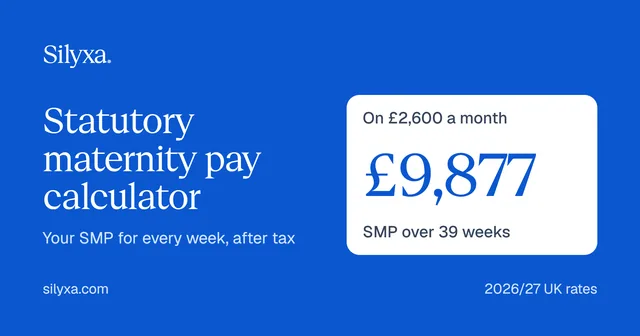
Who gets Statutory Maternity Pay
Statutory Maternity Pay (SMP) is paid by your employer for up to 39 weeks. You get it if you have worked for the same employer for 26 weeks by the end of the qualifying week, the 15th week before the week your baby is due, and your average weekly earnings are at least the lower earnings limit: £129 a week for a qualifying week in 2026/27. You also need to give the right notice and proof of the pregnancy, usually a MATB1.
With a due date of 14 Jun 2027, the qualifying week runs from 28 Feb 2027 to 6 Mar 2027, so you need to have started by 12 Sept 2026. If you don't qualify, you may get Maternity Allowance instead, which has its own test.
Many employers pay more than SMP under their own scheme. The NHS and schools have national ones, which include your SMP: see the NHS maternity pay calculator and the teacher maternity pay calculator.
How SMP is worked out
SMP is 90% of your average weekly earnings for the first 6 weeks, then £194.32 a week or 90% of your earnings, whichever is lower, for the next 33 weeks. The hard part is the average weekly earnings, because they come from the pay you actually received in a set period, not from your salary.
- The end of the period is your last normal payday on or before the Saturday that ends the qualifying week.
- The start is the day after the last normal payday at least 8 weeks before that. That earlier payday itself is not counted (regulation 21(3)).
- Paid monthly: add up the pay, divide by the number of months in the period, to the nearest whole number, then multiply by 12 and divide by 52 (regulation 21(5)).
- Paid weekly, every 2 weeks or every 4 weeks: divide by the number of weeks in the period (SPM171300). Any other period is divided by its days and multiplied by 7.
The average is not rounded. 90% of it is rounded up to the next penny, as GOV.UK's own calculator does.
A worked example
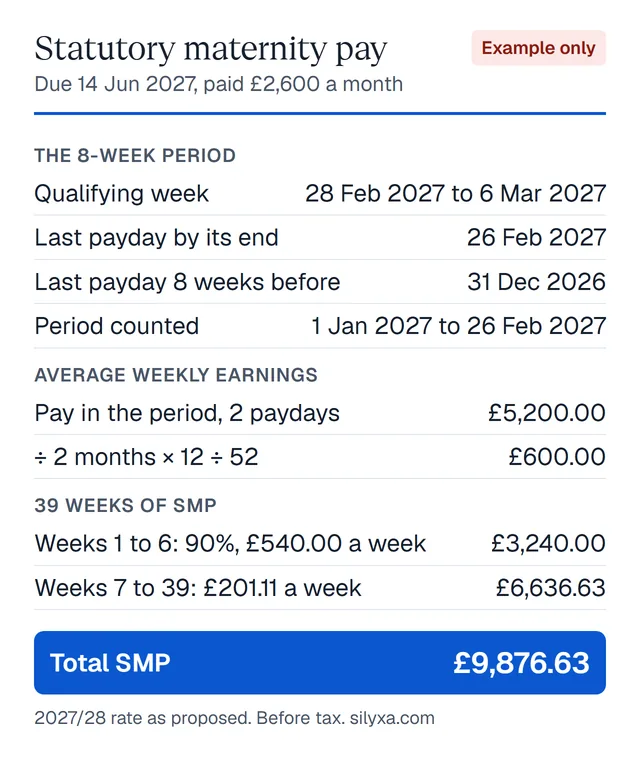
Due on 14 Jun 2027 and paid £2,600 on the last working day of each month. The last payday on or before the end of the qualifying week is 26 Feb 2027, and the last payday at least 8 weeks before it is 31 Dec 2026. So the period runs from 1 Jan 2027 to 26 Feb 2027, with 2 paydays and £5,200 of pay.
£5,200 ÷ 2 months × 12 ÷ 52 = £600.00 a week. SMP is £540.00 for 6 weeks, then £201.11 for 33 weeks: £9,876.63 in total. GOV.UK's calculator gives the same average and the same first 6 weeks for these dates.
Paid £600 every week instead, the period from 9 Jan 2027 to 5 Mar 2027 is 8 weeks with 8 paydays, so the average is £4,800 ÷ 8 = £600.00.
Bonus, overtime and pay rises
Everything you are paid in the period that counts for National Insurance counts, including bonus, overtime and commission (SPM171000). A £1,500 bonus paid in the example period lifts the average to £773.08 and the first 6 weeks to £695.77, adding £934.62 in total. Pay earned in the period but paid after it does not count.
A pay rise that covers any part of the period counts as if you had been paid it for the whole period, even if it is awarded later (regulation 21(7)). A 3% rise in the example gives an average of £618.00. If it comes after your SMP started, your employer has to recalculate and pay the difference.
Salary sacrifice works the other way: the pay you give up is not paid to you, so it does not count, and it can lower your SMP. Enter your pay after the sacrifice.
When 90% is less than the flat rate
For lower earners, 90% of earnings can be below the flat rate. Then you get 90% for all 39 weeks. On £900 a month, the average is £207.69, so every week pays £186.93: £7,290.27 in total. On £500 a month the average is £115.38, below the £129 limit, so there is no SMP at all.
SMP rates and April
The flat rate is £194.32 a week from 5 Apr 2026. The proposed rate for 2027/28 is £201.11, set out in the written ministerial statement of 28 October 2026. The new rate starts with your next full SMP week (SPM220400), so the calculator uses it for weeks starting on or after 4 Apr 2027, the expected date. GOV.UK's employer calculator still shows the current rate for later weeks until the new one is set, so its total can be lower.
Tax on SMP
SMP is paid through payroll like normal pay, so Income Tax, National Insurance, student loan and pension can come off it. Tax is worked out across the tax year, so a month on the lower rate can bring tax back. In the example, a full month on SMP averages about £1,096 after tax, against £2,166 on normal pay. The Month by month tab shows each payslip.
For employers
Employers pay SMP and claim most of it back from HMRC through their payroll: 92%, or 109% for a small employer whose Class 1 National Insurance in the last complete tax year was £45,000 or less. The Employer tab shows the figures.
Statutory maternity pay questions
How much is Statutory Maternity Pay?
90% of your average weekly earnings for 6 weeks, then £194.32 a week or 90% of your earnings if lower, for 33 weeks. The proposed rate from April 2027 is £201.11.
Is SMP taxed?
Yes. It is taxed through payroll like your normal pay, with National Insurance if your earnings are high enough.
Does SMP include my bonus?
Yes, if the bonus is paid in the 8-week period. A bonus paid before or after it doesn't count.
Can I get SMP if I'm self-employed?
No. SMP is paid by an employer. Self-employed people may get Maternity Allowance instead.
Is there a GOV.UK SMP calculator?
Yes, GOV.UK has a maternity calculator for employers. It needs your payday dates and pay in the period. This page works the paydays out from your due date and adds take-home pay.
Is this official?
No. It follows the regulations and HMRC's manual, but your employer works out your actual SMP from your payroll records.
How this calculator works
Statutory Maternity Pay follows regulation 21 of the Statutory Maternity Pay (General) Regulations 1986. The qualifying week is the 15th week before the week the baby is due. The relevant period runs from the day after the last normal payday at least 8 weeks before the last payday on or before the end of the qualifying week, up to that payday. Monthly pay is divided by the months in the period, to the nearest whole number, times 12 and divided by 52. Pay in whole weeks is divided by the weeks, and any other period by its days times 7. A pay rise that covers the period counts as if paid for all of it. Average weekly earnings are not rounded, and 90% of them is rounded up to the next penny, as GOV.UK's calculator does. SMP is that 90% for 6 weeks, then the lower of the flat rate and 90% for 33 weeks, with each week at the rate for the day it starts (£194.32, then the proposed £201.11 from 4 April 2027). You need 26 weeks with the employer by the end of the qualifying week and earnings at or above the lower earnings limit. Take-home uses the shared engine with cumulative PAYE across each tax year.
Sources
Checked on 21 November 2026 against the 2026/27 tax year.
- The Statutory Maternity Pay (General) Regulations 1986, regulation 21
- HMRC Statutory Payments Manual SPM171000: earnings used to calculate average weekly earnings
- HMRC Statutory Payments Manual SPM171300: average weekly earnings, pay in multiples of a week
- GOV.UK Maternity pay and leave: pay
- GOV.UK Statutory Maternity Pay: manually calculate your employee's payments
- GOV.UK Maternity, adoption and paternity calculator for employers
- HMRC Statutory Payments Manual SPM220400: Statutory payment rates
- GOV.UK Proposed benefit and pension rates 2027 to 2028
- GOV.UK Rates and thresholds for employers 2026 to 2027
- GOV.UK Maternity Allowance
Update history
- 23 November 2026: Pension now starts at 0% until you enter yours, so the take-home figures no longer assume a pension you may not pay.
- 21 November 2026: Added.