
What a DEA is
A Direct Earnings Attachment (DEA) is a deduction your employer takes from your pay to repay a benefit overpayment to the Department for Work and Pensions (DWP), or to a council for Housing Benefit. DWP sends your employer a notice, and your employer must take the amount set by law each payday, tell you about it, and pass it on by the 19th of the following month. On a payslip it usually shows as DEA table or DEA fixed.
The amount is a percentage of your net earnings: your pay after Income Tax, National Insurance and pension contributions. A student loan is not taken off first. The more you earn, the higher the percentage. These rules are in Part 6 of the Social Security (Overpayments and Recovery) Regulations 2013 and cover England, Scotland and Wales.
A worked example
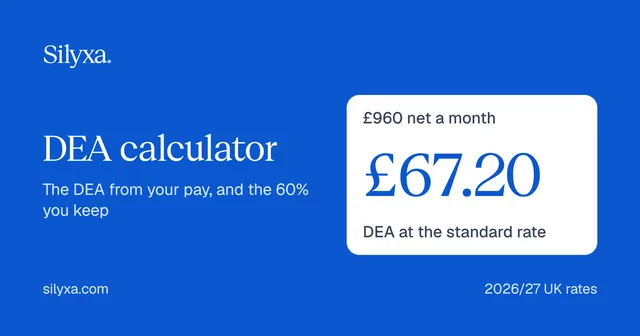
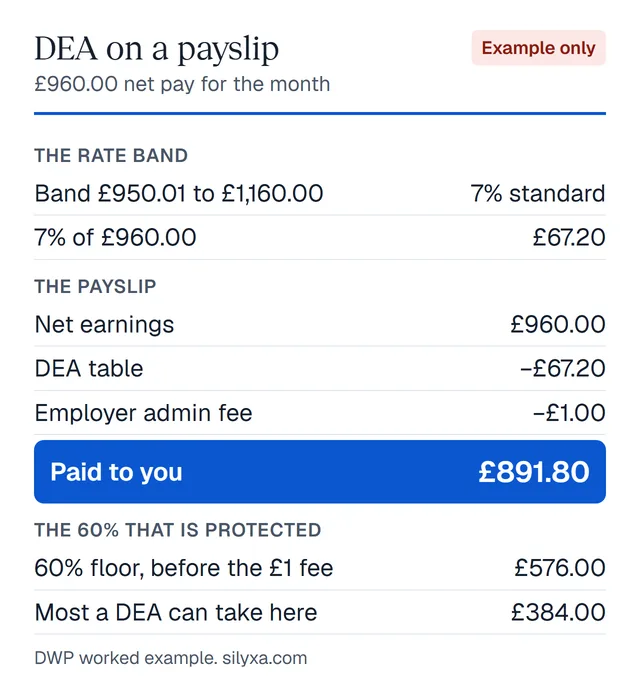
DWP's own example: monthly net earnings of £960.00 fall in the 7% band, so the DEA is £67.20. With the £1 admin fee the employer may add, you are paid £891.80.
Paid every 4 weeks, net pay is divided by 4 and the weekly table used, then multiplied back. On £845.83: £211.46 a week, 5% is £10.57, so the DEA is £42.28 (£84.60 at the higher rate). Every 2 weeks works the same way, divided by 2. Pay for a period that is not a whole week or month uses the daily table: £560.00 for 8 days is £70.00 a day, so the DEA is £84.00, or £168.00 at the higher rate.
Each step is rounded to the penny, and an exact half penny rounds down (regulation 20(4)). Payroll software that rounds differently can be a few pence out. For its 4-weekly higher rate example, DWP's guide shows £21.14 a week, where the regulation's rounding gives £21.15.
DEA rate tables
The standard rate is the usual one. The higher rate is used when you were convicted of an offence over the overpayment. DWP can also set a fixed amount, often lower, which you may be able to agree with them. A fixed amount is still nil if your pay is in the nil band, and still cannot take you below the protected 60%.
| Net pay a month | Standard | Higher |
|---|---|---|
| Up to £430.00 | Nil | 5% |
| £430.01 to £690.00 | 3% | 6% |
| £690.01 to £950.00 | 5% | 10% |
| £950.01 to £1,160.00 | 7% | 14% |
| £1,160.01 to £1,615.00 | 11% | 22% |
| £1,615.01 to £2,240.00 | 15% | 30% |
| £2,240.01 or more | 20% | 40% |
| Net pay a week | Standard | Higher |
|---|---|---|
| Up to £100.00 | Nil | 5% |
| £100.01 to £160.00 | 3% | 6% |
| £160.01 to £220.00 | 5% | 10% |
| £220.01 to £270.00 | 7% | 14% |
| £270.01 to £375.00 | 11% | 22% |
| £375.01 to £520.00 | 15% | 30% |
| £520.01 or more | 20% | 40% |
| Net pay a day | Standard | Higher |
|---|---|---|
| Up to £15.00 | Nil | 5% |
| £15.01 to £23.00 | 3% | 6% |
| £23.01 to £32.00 | 5% | 10% |
| £32.01 to £39.00 | 7% | 14% |
| £39.01 to £54.00 | 11% | 22% |
| £54.01 to £75.00 | 15% | 30% |
| £75.01 or more | 20% | 40% |
The 60% protected earnings floor
Your employer must leave you at least 60% of your net earnings. If a DEA, together with deductions that come before it, would take more than 40%, the DEA is cut so you keep exactly 60% (regulation 20(7)). On £1,500.00 net with £400.00 already taken for another order, the higher rate would be £330.00, but only £200.00 can be taken, leaving £900.00. Anything not taken is carried to later paydays.
Child maintenance deduction from earnings orders always come first. In England and Wales, another court or Council Tax order comes first if it was in effect on the DEA's first payday, otherwise orders go by the date they were made. In Scotland, an earnings arrestment already in effect comes first, otherwise the DEA does (regulation 29). GOV.UK's employer guide tells payroll to treat a student loan like a priority order for the 60% check. Enter these under More options.
The £1 admin fee is the one thing allowed to take you below 60% (regulation 20(9)). Your employer keeps it, and it does not reduce your debt.
How long a DEA lasts
A DEA carries on until the debt is repaid or DWP changes or ends the notice. At £165.00 a month, a debt of £2,000 takes 13 paydays, if your pay stays the same. Enter the total on your DWP letter under More options to see yours.
DEA questions
How is a DEA deduction calculated?
Take your net earnings for the pay period, find the band in the rate table for how often you are paid, and take that percentage. For 2- or 4-weekly pay, work it out per week and multiply back. Then check the DEA plus deductions taken first leaves you at least 60% of net pay.
What does DEA table or DEA fixed mean on my payslip?
DEA table means the amount comes from the rate tables. DEA fixed means DWP set a fixed amount in its notice to your employer.
How do I find out what a DEA is for?
DWP Debt Management deals with the debt, and its letter explains what you owe. Contact them if you need help with repayments or think too much has been taken: see paying back a benefit overpayment on GOV.UK.
Can I pay back less?
You can ask DWP Debt Management to agree a lower fixed amount. Your employer cannot change the amount themselves.
Does a DEA come out of sick pay or maternity pay?
Statutory Sick Pay counts as earnings, so a DEA can be taken from it. Statutory Maternity, Paternity, Adoption, Shared Parental, Neonatal Care and Parental Bereavement Pay do not count, and nor do expenses or statutory redundancy pay.
Can a DEA take more than 40% of my pay?
No. With everything taken first, it stops where you keep 60% of your net earnings. Only the £1 admin fee can go past that.
What if my pay changes each month?
The DEA is worked out again each payday on that payday's net earnings, so it goes up and down with your pay. If too little was taken one payday, the shortfall is taken on later paydays.
Does this apply in Northern Ireland?
The Department for Communities issues DEAs in Northern Ireland under its own regulations (SR 2016/224), with the same bands, the same 60% protected earnings and the same £1 fee. See benefit debt deductions on nidirect.
How this calculator works
Direct Earnings Attachment follows Part 6 of the Social Security (Overpayments and Recovery) Regulations 2013, as amended, for England, Scotland and Wales. Net earnings are pay less Income Tax, Class 1 National Insurance and pension contributions (regulation 17(4)); a student loan is not taken off. The rate comes from Schedule 2: Table A or C for weekly pay, B or D for monthly pay, and DWP's daily bands for any other period. Pay every 2 or 4 weeks is divided by 2 or 4, worked on the weekly table and multiplied back, rounding to the penny at each step as DWP's guide does, with an exact half penny rounded down (regulation 20(4)). The DEA, with deductions taken first and a student loan, never leaves less than 60% of net earnings (regulations 17(1), 20(7) and 29); the optional £1 admin fee may (regulation 20(9)). In gross mode, net earnings are estimated with this year's Income Tax and NI for a year paid the same way. The payoff is the debt divided by the DEA, rounded up to whole paydays. Tests reproduce DWP's three worked examples: £960 a month gives £67.20, £845.83 every 4 weeks gives £42.28, and £560 for 8 days gives £84.00, or £168.00 at the higher rate.
Sources
Checked on 27 November 2026 against the 2026/27 tax year.
- Social Security (Overpayments and Recovery) Regulations 2013, regulation 17: earnings, net earnings and protected earnings
- Social Security (Overpayments and Recovery) Regulations 2013, regulation 20: amount of the deduction
- Social Security (Overpayments and Recovery) Regulations 2013, regulation 29: priority between notices and orders
- Social Security (Overpayments and Recovery) Regulations 2013, Schedule 2: DEA rate tables
- GOV.UK Make benefit debt deductions from an employee’s pay, calculating a DEA
- GOV.UK Make benefit debt deductions, what counts as earnings
- GOV.UK Direct Earnings Attachment, a guide for employers
- GOV.UK Direct Earnings Attachment, a more detailed guide
- Social Security (Overpayments and Recovery) Regulations (Northern Ireland) 2016, Part 6
- nidirect Benefit debt deductions from your pay
Update history
- 28 November 2026: Added.